
English as a Second Language (ESL) at Saint Joseph Seminary College
Saint Joseph Seminary College offers ESL instruction and support as needed, welcoming non-English speakers of all ability levels. The ESL Division provides small-group instruction, one-on-one tutoring, and computer-assisted learning programs. Seminarians studying ESL also participate in a variety of formation activities with their English-speaking peers, giving them increased opportunities to practice their new language and to integrate with the whole of the seminary community. The goal of the ESL Division is to equip ESL students with sufficient proficiency in English to succeed in an English curriculum at the college level, especially the propaedeutic and discipleship stages of seminary formation.
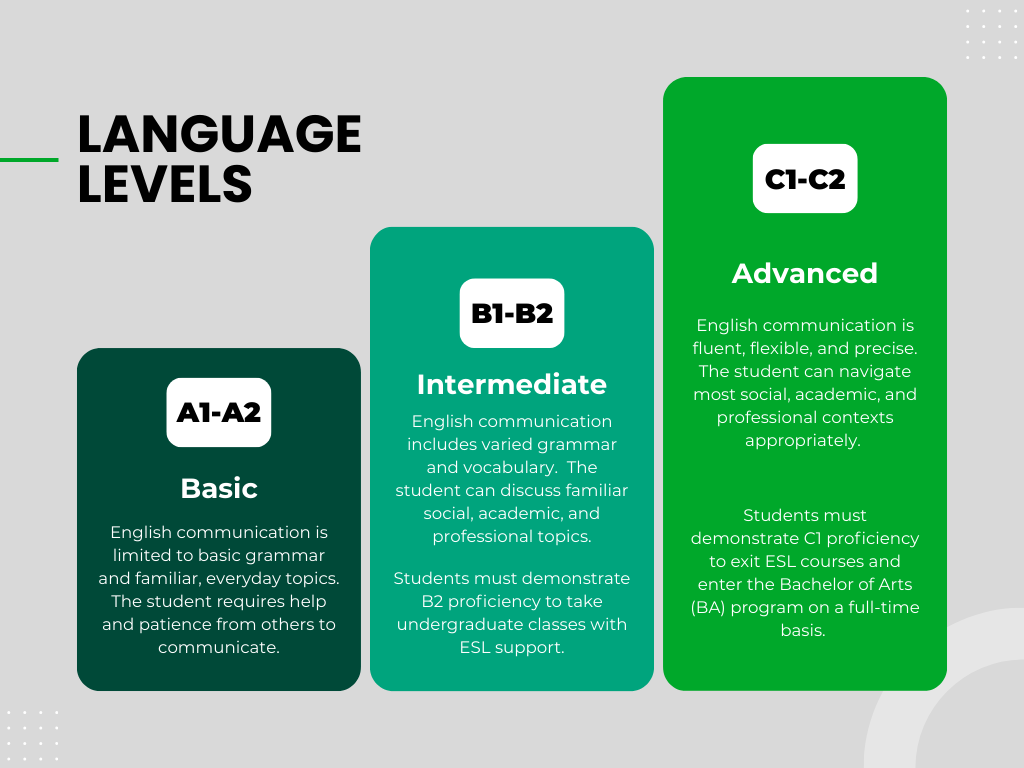
The ESL Division uses the CEFR Global Scale (see graphic below) to determine the English proficiency and appropriate level of instruction for each ESL student. Incoming ESL students are given an ESL placement exam during orientation. Regular assessments are also given throughout a student’s ESL studies to determine the appropriate instruction and courseload for each ESL student, and serve as the primary indicator of a student’s level of English proficiency. The Kaplan Test of English (KTE) is the placement exam normally given by the ESL Division.
Normally, students with a basic CEFR ranking (A1-A2) will need three years of instruction to reach proficiency, while students with an intermediate CEFR ranking (B1-B2) will need two years. Advanced students (C1-C2) who are competent overall but have skill gaps in one or more areas are often able to transition into undergraduate coursework within one year. However, additional factors, such as the student’s educational background, native language, approach to learning, and future educational goals can also affect the time it takes a student to reach proficiency. Other forms of remedial instruction, such as tutoring for earning high school equivalency or improving general academic skills, can also extend a student’s projected duration of ESL studies.
ESL Policies and Procedures
ESL students must attain a CEFR ranking of C1 on a placement exam to fully exit ESL coursework with the approval of the ESL Director and Academic Dean. Students with a CEFR ranking of B2 may, with the approval of the ESL Director and Academic Dean, transition to part-time ESL coursework alongside for-credit coursework.
Non-ESL students referred to the ESL Division for Language Support must take an ESL placement exam. Non-ESL students with an overall score below B2 must withdraw from for-credit courses and enroll in ESL full-time. Students at B2 proficiency may be allowed to continue for-credit coursework alongside ESL coursework, with the approval of the ESL Director and Academic Dean. Students at C1 proficiency are provided one-on-one tutoring or language classes as appropriate.
Demonstration of consistent progress is required for remaining enrolled in ESL studies at Saint Joseph Seminary College. Students whose ESL skills regress or stagnate for two consecutive semesters are placed on ESL probation for the following semester. While on ESL probation, ESL students are required to complete additional weekly tutoring. Part-time ESL students placed on ESL probation are normally required to transition to ESL full-time. An ESL student normally comes off ESL probation with the approval of the ESL Director and Academic Dean after achieving a full level increase in his overall language proficiency score (for example, from B1 to B2). In rare cases, ESL probation may be extended beyond one semester with the approval of the ESL Director and Academic Dean. Failure to show sufficient signs of progress may result in the Academic Affairs Committee recommending the student’s suspension for at least one semester, at the end of which the student may apply for readmission to Saint Joseph Seminary College.
CEFR Rankings Used to Track ESL Progress
ESL Course Descriptions
The following are the standard courses offered for ESL students. Course registration for ESL students is finalized by the ESL Director based on individual student needs.
Basic Courses (CEFR A1-A2)
Integrated Skills (6 hours)
This course covers foundational grammar elements and basic vocabulary, giving students the opportunity to apply this information in a variety of authentic contexts. Though focused on grammar and vocabulary, this course also involves reading, writing, listening, and speaking practice.
Speaking and Listening (3 hours)
In this course, students develop their ability to communicate in English. They receive detailed scripts for navigating a variety of situations in English and learn to organize their thoughts, share information clearly and concisely, rephrase unclear statements, and seek clarification. Students also learn about techniques to aid listening comprehension in English, such as active listening, using context clues, and recognizing non- verbal communication.
Tutorial (3 hours)
This course is individualized each term for the students currently enrolled. Likely topics at the basic level include pronunciation review, sentence writing, and reading fluency.
Intermediate Courses (CEFR B1-B2)
Intermediate Integrated Skills (3 hours)
This course reviews some basic grammatical foundations before moving on to the more advanced structures needed for academic writing. Students learn a variety of strategies for vocabulary comprehension and retention and apply these strategies to both spoken and written English. In this course, students also work on introductory reading and writing skills.
Intermediate Speaking (3 hours)
At the intermediate level, students receive a dedicated speaking course. This allows for intensive pronunciation review and communicative practice in a variety of authentic language contexts. Rather than relying on formulaic scripts, students at this level are taught how to handle more spontaneous dialogues. Students learn how to share ideas in a college classroom, how to respectfully disagree with peers and authority figures, and how to seek assistance in an academic setting. They also practice presentations, interviews, and scripture readings.
Intermediate Listening (3 hours)
This course will focus on listening in academic contexts. Students will work with short, digestible portions of college lectures. They will receive explicit instruction in signaling vocabulary, listening strategies, and notetaking. By the end of this course, students will be ready to apply these skills to longer listening tasks on a variety of topics.
Intermediate Tutorial (3 hours)
This course is individualized each term for the students currently enrolled. Likely topics include vocabulary, introductory writing skills, reading, and college readiness/study skills.
Advanced Courses (CEFR C1-C2)
Academic Writing (3 hours)
In order to prepare non-native English speakers for college writing, this course covers generating ideas, paragraphing, high-level grammar, transitional elements, formatting and citation standards, and drafting, revising, and editing papers. An emphasis on accurate and appropriate summarizing and paraphrasing is also included.
Academic Reading (3 hours)
Intended for students with a solid foundation in English grammar and vocabulary, this course encourages students to actively engage with academic texts. Competency is demonstrated by the ability to accurately summarize the material in both spoken and written English. Students also develop opinions and arguments based on a close analysis of the material and must clearly convey these ideas. Students interested in this course should be comfortable reading large amounts of text in English.
Advanced Speaking and Listening (3 hours)
Students build on the skills developed in Intermediate Speaking and Listening, with a focus on communicating in high level academic situations, including interviews, debates, and presentations. Students also fine-tune active listening skills in preparation for full participation in college lectures.
Advanced Tutorial (3 hours)
This course is individualized each term for the students currently enrolled. Likely topics include specialized vocabulary (philosophy, theology, music, etc.), public speaking, college readiness/study skills, and professional communication.